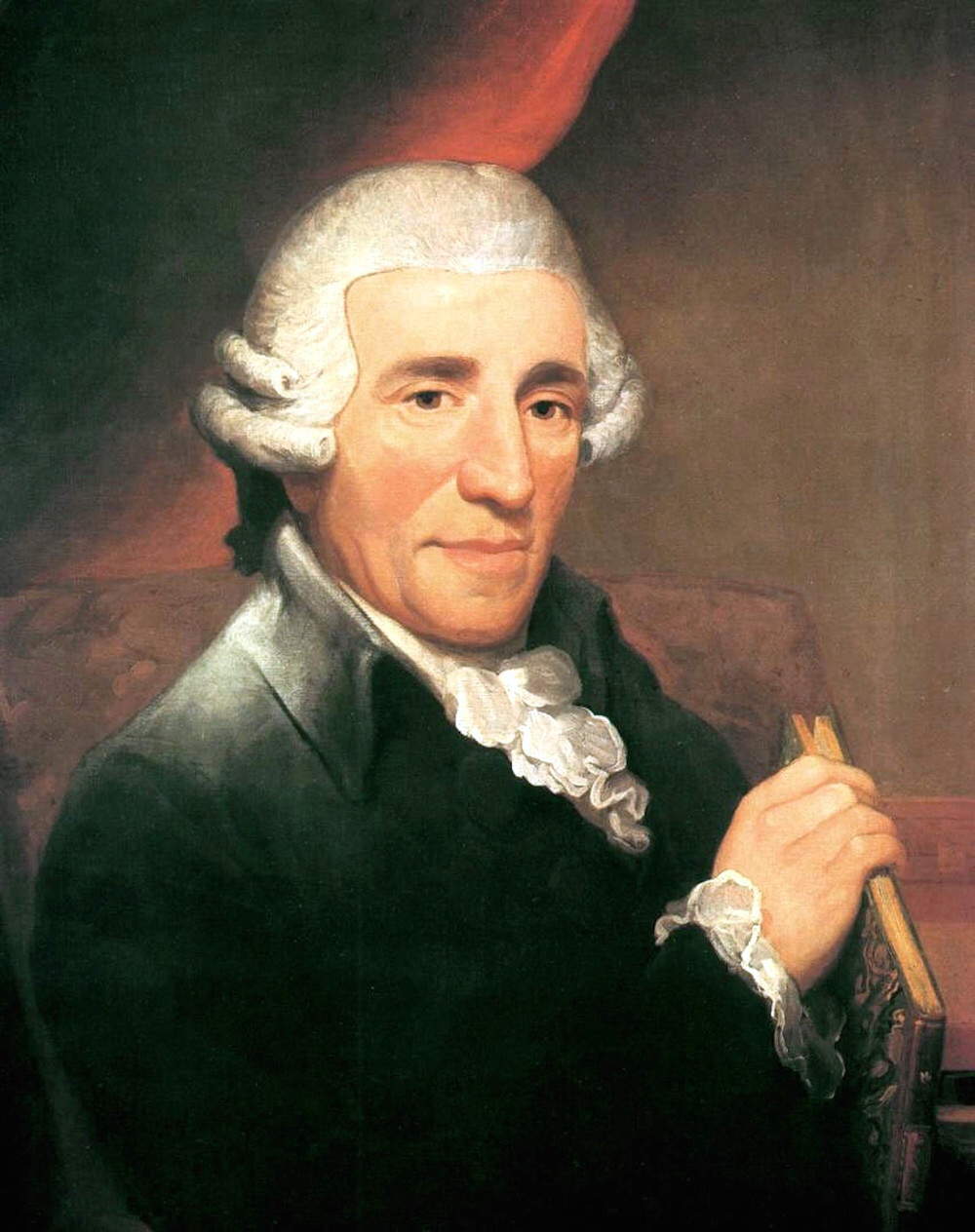
 This month we will be talking about Austrian composer Franz Joseph Haydn. He was one of the most revered and important composers of the Classical Period. Haydn’s court musicians and Mozart himself affectionately called him Papa Haydn because of his good-nature, sense of humor, generosity, and kindness. He is also nicknamed the Father of the Symphony and the Father of the String Quartet for his advancement of these musical genres.
During our lesson time we will be talking a little bit about Haydn. Our homework will be to color the Haydn coloring page while enjoying some of his music (some suggestions and a short biography are given below). After listening to his music fill in the three blank lines on the coloring page with answers to the prompt: “Haydn’s music makes me think of…”
SUGGESTED VIDEOS FOR LISTENING HOMEWORK:
Symphony no. 45 in F-sharp minor (Farewell Symphony) – When Prince Nicolaus I traveled to his country palace at Eszterhaza, he took his household with him, including his musicians. The musicians’ wives and children usually stayed behind in Eisenstadt, about a day’s journey away. During one particular trip, the Prince stayed longer than planned and the musicians missed their families. Wishing to return home, they asked Haydn (their Kapellmeister) for help. Instead of talking directly to the Prince, he wrote the Farewell Symphony. During the performance of the final movement’s adagio, each musician stopped playing, snuffed out the candle on his music stand, and left. At the end of the piece only Haydn and his concertmaster, Luigi Tomasini, were left playing their violins. The Prince seemed to have understood the message and they all returned to Eisenstadt soon there after. In the video below you can see the musicians leaving one by one (including the conductor), with only two violinists remaining at the end. It is a really dramatic statement! Watch for the double bass leaving at 25:38 (that could not have been easy!!).
Symphony no. 94 in G major, 2nd movement (Surprise Symphony) – Haydn had a wonderful sense of humor and his music is full of little jokes. Haydn composed this piece for a series of concerts during his first visit to London (1791-1792). He wanted to go in with a bang and surprise the audience with something new and exciting. The music starts out very softly and then suddenly a fortissimo chord! The music then returns to the soft dynamics as if nothing had happened. Listen and see if it makes you jump in your seat!
Piano Sonata No. 59 in E flat major Hob. XVI/49 – Haydn composed 62 piano sonatas as well as a variety of other piano pieces. This particular sonata is considered to be one of his finest and was used in the 1994 movie “Interview with the Vampire” starring Tom Cruise and Brad Pitt, as well, as the third installment of the strategy video game series Civilization. Haydn dedicated this piece to his friend and amateur musician Maria Anna von Genzinger.
National Anthem of Germany – The power of the English patriotic anthems, like “God Save the King”, made such an impression on Haydn that, after his return from London, he decided that Austria needed one as well. So in 1797 he set out to compose such a piece in celebration of Emperor Francis II’s birthday. This beautiful and powerful anthem was later adopted by Germany in 1922 and named Das Deutschlandlied (The Song of Germany).
String Quartet in E Flat, Presto ‘The Joke’ – Haydn was a bit of a prankster, especially as a young man. This string quartet is nicknamed ‘The Joke’ because Haydn created several false endings to try to trick the audience into clapping! And then he ended the piece when everyone expects the music to keep on going!
A SHORT BIOGRAPHY OF Franz joseph haydn:
Franz Joseph Haydn was born on March 31, 1732 in Rohrau, Austria, a village on the border with Hungary. His father, Mathias, was a wheelwright and his mother, Maria, was a former cook in a local palace. Little Haydn had a beautiful and pure singing voice which his parents were quick to recognize. At the age of 5, Hadyn was sent him to live with a cousin, Johann Mathias Franck, to obtain a good musical education. When he was 8 years old he became a choir boy at Vienna’s Cathedral of St. Stephen, one of the leading musical centers of Europe. He worked as a choirster for nine years until he decided it would be funny to cut off the pigtail of one of his fellow choirsters. He was immediately dismissed from the choir and sent out to live on the streets. He started working as a freelance musician, earning as much as he could as a music teacher and a street serenader. He spent every spare moment studying intensely every detail of Johann Joseph Fux’s Gradus ad Parnassum and Carl Philip Emanuel Bach’s six piano sonatas. He was determined to improve his musical knowledge and composing abilities. He eventually became the valet-accompanist of Italian composer Niccolo Porpora, from whom Haydn said that he learned “the true fundamentals of composition.” Haydn worked and studied very hard for 8 long years living in extreme poverty and barely making enough money to eat.
Slowly he began to gain access to the nobility and in 1757 he became Kapellmeister (music director) for Count Morzin. He wrote symphonies and led the Count’s small orchestra. In 1760, having established a secure job, he married Maria Anna Keller. Haydn had fallen in love with Maria’s younger sister, Theresa, but her family had intended her for the church (and, in fact, she became a nun), so they suggested Maria and Haydn marry. Unfortunately, it turned out to be a very unhappy marriage… Maria had a volatile temper and no appreciation for music. It is said that she used Haydn’s manuscripts as pastry liners and curling papers! They remained married until her death in 1800. They had no children.
Count Morzin was going through financial difficulties and decided to dismiss his expensive musicians. Haydn was soon offered the position of vice-conductor by Prince Paul Anton Esterhazy. The Esterhazy family was at the top of the powerful Hungarian nobility. This was a very prestigious position for the young composer and he accepted the offer with great enthusiasm. He was off to live at the court of Eisenstadt in Hungary!
Haydn remained in the service of the Esterhazy for 30 years! When the old Kapellmeister, Gregorius Joseph Werner, died, Haydn assumed his position. He wrote symphonies, operas, chamber music, cantatas, among other musical genres for the court of the Princes, first Prince Paul Anton (1761-1762) and then, upon his death, his brother Prince Nicolaus I, the Magnificent (1762-1790). Prince Nicolaus, especially, was a great lover of music and he kept Haydn and the court musicians constantly busy. The Prince loved a now obsolete stringed instrument named the baryton, which was related to the viola da gamba. It looks somewhat like a cello but has no end pin on which to stand the instrument on the floor. It must be held up by the legs, which straddle the baryton. Besides the 6 bowed strings on the front of the instrument, there were also a set of 10 plucked strings on its back. It was a very difficult instrument to play which may have been what attracted the Prince to it in the first place. Below you can see a video about the baryton:
Since the Prince enjoyed playing chamber music with his musicians in his private apartments, Haydn wrote many baryton compositions for the Prince, his most celebrated being the Baryton Trios.
His contract with the Esterhazy princes required him to conform to a rigid code of conduct that kept his relationships with his musicians at a strictly professional level. He also felt isolated from friends and family since he was rarely granted permission to leave, even for short trips. Even so, through his clever diplomacy, he was able to travel on occasion to Vienna. He was also able to publish some of his work which quickly circulated throughout Europe. By the 1780s, Haydn was the most celebrated and respected composer in Europe.
In 1790, Prince Nicolaus I died. His son, Prince Anton, succeeded him and since he did not care much for music, dismissed all the Esterhazy musicians with the exception of Haydn, Tomasini and a few instrumentalists needed for church services. Prince Nicolaus had left Haydn with a very generous yearly pension, which in theory kept him employed by the Esterhazy, but he was now free to do whatever he wanted to. Haydn jumped at the opportunity and immediately headed to Vienna. He started to receive offers from all over Europe: Prince Anton Grassalkovics’ court at Pressburg, King Ferdinand IV of Naples, and London! He thought long and hard about Italy versus England… He had dreamed for years to travel to Italy, but the prospect of returning to a life at court was not at all appealing now that he had tasted the freedom of being able to compose whatever he wanted and go wherever he pleased. So in 1791 Haydn made his first of two trips to London.
Haydn had never traveled beyond the small area around his homeland and the Esterhazy palaces and, although he was fluent in Italian, he did not speak a single word of English. The shear size of London and its traffic and noise surprised Haydn greatly. He kept meticulous diaries of all the things he discovered in London, nothing was too small to escape his notice (from the number of carts for cleaning the streets to the number of cartloads of coal the city consumed annually). His visit to London was a monumental success, his music was received with enormous enthusiasm. He returned to London for a second time in 1794.
In 1795, a new prince was head of the Esterhazy family, Prince Nicolaus II. He shared his grandfather’s enthusiasm for music, so Haydn returned to the service of the Esterhazy. Luckily for Haydn, Prince Nicolaus II preferred the family palace in Vienna to the country palace of Eszterhaza. But, of the four Esterhazy princes Haydn worked for, Prince Nicolaus II proved to be the least pleasant and was considered to be every bit the despot. Haydn and the Prince rarely saw eye-to-eye.
In May of 1809, Napoleon launched an attack on Vienna and Haydn’s neighborhood was bombarded, with cannons falling mere yards from his home. In the midst of the attack, he called out to the frightened people, “Don’t be afraid, children, where Haydn is, no harm can reach you!” His words turned out to be true, for Napoleon had such an admiration and respect for Haydn, that when Vienna fell to the French forces, he placed a guard of honor at Haydn’s front door to make sure nothing happened to the composer.
Haydn died soon after on May 31, 1809 in Vienna at age 77.
After his death, his adventures did not end… Austria was still at war with Napoleon, so Haydn was given a highly honored but rather quick burial in Vienna. In 1814, Prince Nicolaus II requested that Haydn’s body be moved to the Esterhazy estate in Eisenstadt. The request was granted but when his body was exhumed, officials were shocked to find that Haydn’s head was missing (though his wig was still in the coffin)! Two amateur phrenologists (a debunked science that claimed to determine personality traits by analyzing the bumps on one’s skull) had bribed the gravedigger to remove his head. They had hoped to learn about Haydn’s genius by studying his skull. When the prince found out he was furious! He eventually offered one of the thieves a handsome sum to return it, but was instead given someone else’s skull. After being passed around for years, Haydn’s skull ended up on display at the Vienna Gesellschaft der Musikfreunde (Society of Friends of Music) in Vienna until 1954 when it was finally reunited with the rest of his remains in a grand ceremony. It took 145 years for Haydn to be whole once more! The fake skull given to the prince was not removed, so now there are two skulls in Haydn’s tomb!
A few more interesting facts about Haydn:
- He was not considered to be a handsome man. He himself once stated that “he couldn’t understand how it happened that in his life he had been loved by many a pretty woman. ‘They couldn’t have been led to it by my beauty'”. He had survived smallpox as a child which left his face pitted with scars. For most of his adult life he suffered from nasal polyps which disfigured his nose and caused him great pain, often to the point of preventing him from working.
- Haydn was a devout Catholic, in fact, he was named after two Catholic saints whose feast days were close to Haydn’s birth date: Franz for St. Francis de Paola and Joseph for St. Joseph, the husband of Mary. Like Bach, he expressed his love for God in his music. He began the manuscripts of his compositions with the Latin phrase In nomine Domini (in the name of the Lord) and ended them with Laus Deo (praise be to God). Whenever he had trouble composing, he picked up his rosary to pray, which comforted him and helped him move beyond his writer’s block.
- On one of his brief visits to Vienna during his tenure with Prince Nicolaus I, Haydn met Wolfgang Amadeus Mozart who had been a celebrated prodigy as a child and was now gaining fame as a brilliant composer. It is not certain when the two met for the first time but by 1781 they were already forming a very close friendship. Haydn was 24 years older than Mozart and their personalities were so different, Haydn being generally calm and cheerful with a great sense of humor, while Mozart was dramatic and moody. But despite these differences, they had so much respect for each other, always speaking of the other with the highest esteem and affection. Mozart dedicated six quartets to Haydn (The Haydn Quartets – K387, K421, K428, K458, K464 and K465) and affectionately referred to him as ‘Papa’, a nickname Haydn had received from his Esterhazy court musicians. Haydn said of Mozart, “Mozart is the greatest composer the world possesses now.” When news reached Haydn in London in 1791 that Mozart had died, he refused to believe the news (Haydn himself had been reported to have died several times and on one such occasion a special concert was being prepared in Paris to honor his life. When he learned of it, he jokingly replied, “Had I only known in time, I could have traveled to Paris to conduct the Requiem myself!’). However, when he received confirmation that the news about Mozart was indeed true, he was beside himself with grief. Even in later years, he could not come to terms with the premature death of his dear friend and the mere mention of Mozart’s name would cause Haydn to openly cry and say, ” Forgive me, I must ever, ever weep when I hear the name of my Mozart.”
- In 1792, a young Beethoven had hoped to study with Mozart, but, due to Mozart’s untimely death, he became Haydn’s pupil instead. It was an unfortunate pairing… Haydn was very busy with his composing and could not provide Beethoven with the guided instruction he desired. They were also extremely different, Beethoven’s tempestuous and suspicious personality often frustrated Haydn. Their political views were also polar opposites, with Haydn being loyal to the Austrian monarchy while Beethoven saw greatness in Napoleon (until Napoleon proclaimed himself Emperor, that is) and embraced the principles of the French Revolution. Beethoven soon moved on… they did not part on unfriendly terms but Beethoven often said that he had learned nothing from Haydn.
- Haydn’s life was one of hard work with a cheerful attitude. Everything he achieved was the result of his dedication to his music. He had the good fortune to have been appreciated and revered during his lifetime, which he deserved. Throughout his life he maintained the same sense of wonder and excitement for learning as well as his humility, despite all the praise lavished upon him. He often said that composing did not come easily to him, but that he had to work very hard to create his music.
References and further information:
- Geiringer, Karl. “Haydn: A Creative Life in Music,” University of California Press, 1982.
- Lunday, Elizabeth. “Secret Lives of Great Composers,” Quirk Books, 2009.
- Kavanaugh, Patrick. “Spiritual Lives of the Great Composers,” Zondervan Publishing House, 1996.
- Alan Bennett’s The Man and the Music – Joseph Haydn
- The Birth of British Music: Haydn the Celebrity, BBC.
- Deutschlandlied (Song of Germany), Wikipedia.
- Beethoven and Haydn: Their Relationship, Classic fM.
- Getty Images: Returning Haydn’s Skull, 1954.
Children’s books:
- Celenza, Anna Harwell. “Haydn’s Farewell Symphony – Once Upon a Masterpiece,” Charlesbridge, 2016.
 This month we are learning about the godfather of classical music, Johann Sebastian Bach (or as one of his sons, C.P.E. Bach, very lovingly referred to him, “the old wig”). Bach’s music is admired and loved for its beauty, spirituality, drama, and consoling and reassuring nature. As soprano Nancy Argenta has said, “When you’re feeling frazzled, you need Bach not Beethoven to relax you. He has a calmness that makes people feel that all’s well with the world and that they’ll be all right.”
 soliviapiano.com