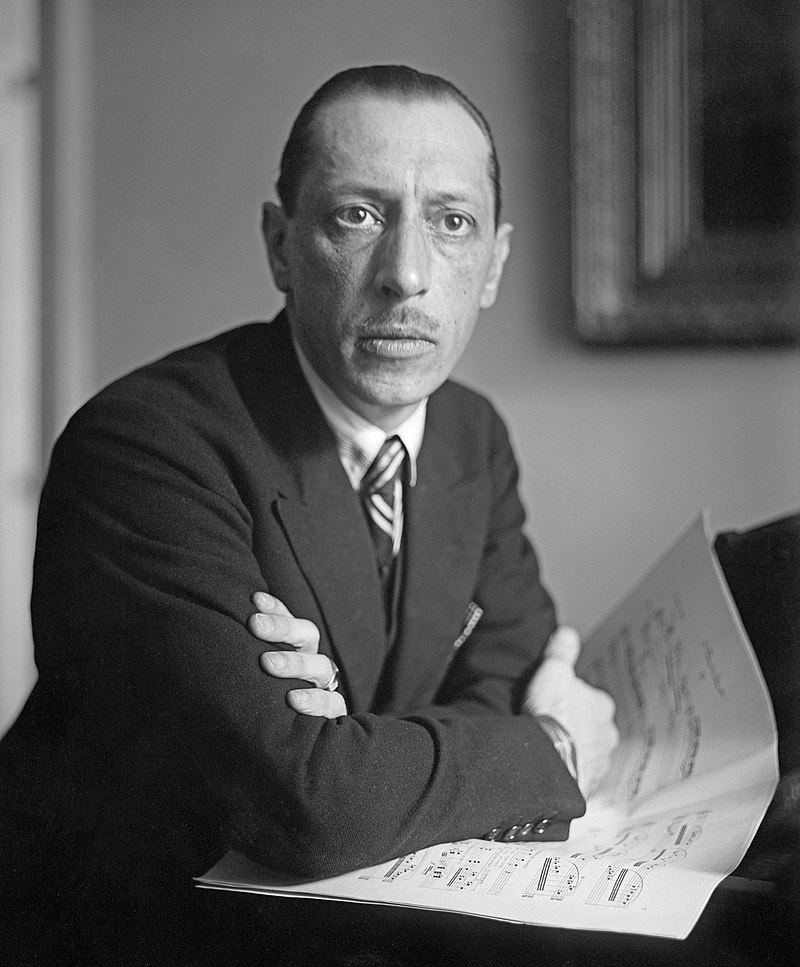
Igor Fyodorovich Stravinsky was the greatest and most influential composer of the 20th century. His exciting and, oftentimes, shocking rhythmic sounds changed classical music forever. He had a unique talent for constantly reinventing himself, which made the music he composed in his 80s as interesting and new as when The Rite of Spring made its first appearance to an unsuspecting musical world in 1913.
During our lesson time we will be talking a little bit about Stravinsky. Our homework will be to color the Stravinsky coloring page while enjoying some of his music (some suggestions and a link to a short biography are given below). After listening to his music fill in the three blank lines on the coloring page with answers to the prompt: “Stravinsky’s music makes me think of…”
SUGGESTED VIDEOS FOR LISTENING HOMEWORK:
The Rite of Spring: Riding on the enormous success of their previous two ballets (Petrushka and The Firebird), Sergei Diaghelev commissioned resident composer Stravinsky to compose music for a new ballet for his Ballets Russes. Stravinsky decided to use an ancient Russian folk tale about the primitive peoples of Russia. The star and coreographer of the ballet company, Vaslav Nijinksy, was on-board to create something completely new and exciting. The result on May 29, 1913 was the most famous classical music scandal ever! Audiences were used to music of the Romantic era, in which, feelings and emotions were central to the musical themes. The pulsating rhythms and dissonant sounds of Stravinsky’s music must have certainly sounded extremely shocking to the audience! One critic commented that, “The music always goes to the note next to the one you expect!” The audience started booing and hissing almost as soon as the ballet began. This soon turned into screaming and shouting which quickly degenerated into fighting throughout the theater. One spectator was said to be punching in rhythm with the music! The noise was so loud that the dancers could not hear the music, so Nijinsky stood on a chair at the edge of the stage (with Stravinsky holding him firmly by his coattails so he would not fall off!) shouting out the numbers for the dancers, who carried on the performance despite the chaos! For more on the debut of The Rite of Spring, check out PBS’s article Stravinsky’s The Rite of Spring.
The Firebird: This ballet is based upon the mythical Firebird, a beautiful creature that glows brightly in red, orange, and yellow. At the beginning of the story Prince Ivan Tsarevich is out hunting and ends up in the magical kingdom of the evil sorcerer, Kashcei. Ivan chases and captures the Firebird. He then releases her when she begs him for her life. Because of his kindness she tells him that she will help him whenever he needs her and gives him a magical feather that he can use to call her. Prince Ivan then encounters 13 princesses who dance around him. He falls in love with one of the princesses and with the help of the Firebird he is able to save her from Kashchei.
Piano Sonata (1924): Stravinsky composed this piano sonata in the summer of 1924 when he was in Biarritz and Nice (France).
Piano-Rag-Music: When Stravinsky moved to France, he “discovered” American jazz music. Jazz was becoming extremely popular all across America and Europe. In this piece, Stravinsky mixes ragtime rhythms and harmonies with Russian elements.
A Conversation with Stravinksy: Up until now, all of our composers lived before any sort of recording device had been invented… But now we can listen to Stravinsky himself talk about his music and how he composed! In the video he tells us that most of his orchestral music was first composed on the piano so he could hear the sounds he heard in his head. Once he was happy with his composition he then orchestrated it.
Stravinsky in Rehearsal Conducting ‘Scherzino’ from Pulcinella: Stravinsky started conducting at the age of 50 because he was in need of money. Although he was never considered a world-class conductor, he had very strong opinions about how his own music should be performed. His instructions were often difficult to understand, but the orchestra musicians were more than happy to do whatever he wanted them to do just because he was Stravinsky! The fact that he recorded so many of his own orchestral works gives today’s music students wonderful material to use in their studies of his music.
BIOGRAPHY of Igor Stravinsky
For a biography of Igor Stravinsky check out Encyclopedia Britannica’s entry Igor Stravinsky.
CHILDREN’S BOOKS:
- “Igor Stravinsky” by Mike Venezia, ISBN-10: 0516200542
- “When Stravinsky met Nijinsky: Two Artists, Their Ballet, and one Extraordinary Riot” by Lauren Stringer, ISBN-10: 0547907257
- “The Tale of the Firebird” by Gennady Spirin, ISBN-10: 0399235841
 soliviapiano.com